

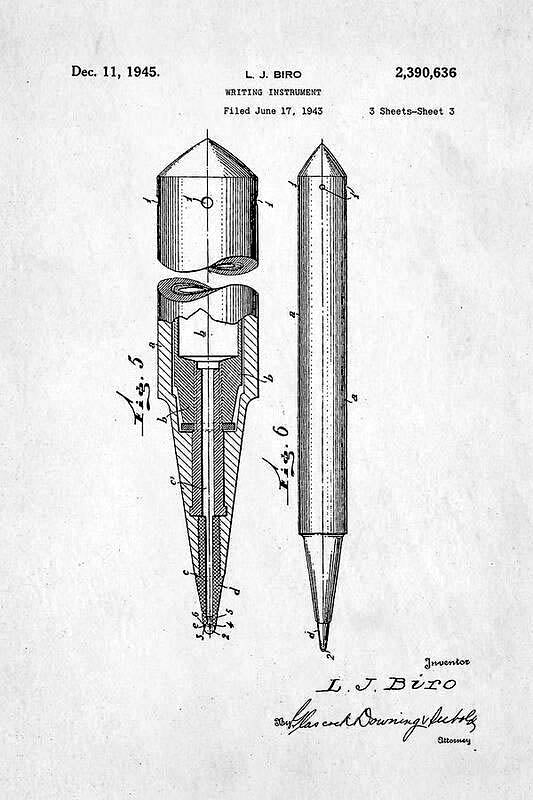
In 1930s Budapest, a journalist named László Bíró spent his days around printing presses. Something bothered him. The ink that printed the newspaper dried almost instantly, but the ink in his fountain pen smudged, leaked, and dried out. He thought, why couldn't a pen use newspaper ink?
Well, the thick, fast-drying ink won't flow through a fountain pen's nib. The answer came to him from watching children play with marbles. A marble rolled through a puddle and left a clean, wet line behind it. Could we roll the ink instead? A tiny ball, spinning freely, could coat itself with thick ink on the inside and roll it onto the paper.
Bíró's brother György was a chemist, and together they built the tip and the ink. They patented it in Paris in 1938. The Bírós were Jewish, and they fled Nazi-era Europe, landing in Argentina in 1943.

László Bíró and his brother György perfected the ballpoint in Buenos Aires. With their partner Juan Jorge Meyne, they sold it as the Birome. To this day, a pen in Argentina is called a birome.
A Frenchman named Marcel Bich bought the patent, and his company you may have heard of, BIC. They sell billions of pens a year.
Every pen we make rolls ink onto paper exactly the way Bíró saw it in that puddle. The modern pen was perfected in Argentina, and noble. note was designed there too, by our Industrial Designer Tomás Rivero in Buenos Aires.
Want to see our pen collection? Made from metals carrying their own history and filled with ink made for space, noble. pens.
Whats the difference between Aluminum 6K & 7K?
What titanium feels like in your hand.