

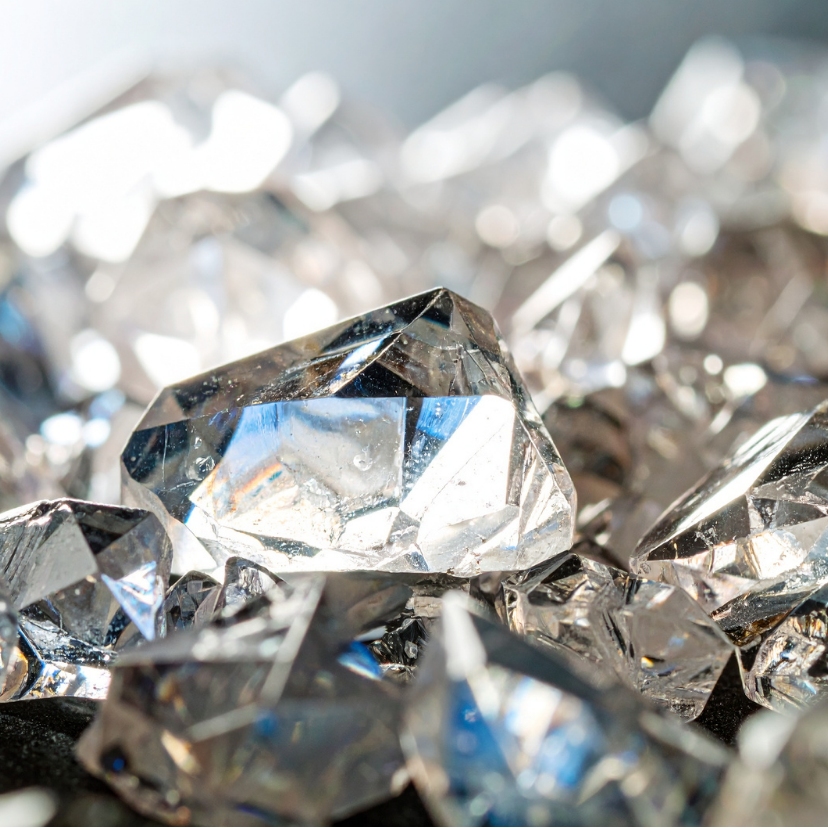
For centuries, people tried to make diamonds. Diamond is only carbon, the same element as pencil lead and charcoal, but with its atoms locked in a tighter pattern. In nature, it forms deep underground under crushing pressure and heat. Alchemists failed to copy it, scientists failed too, and a few just faked it.
In the 1950s, General Electric decided to try again. The effort was called Project Superpressure. They spent a fortune on a press twenty-five feet tall, housed in its own three-story building, pushing over a million and a half pounds per square inch. But, it didn't work.
On the team was a young chemist named Tracy Hall. He believed the problem wasn't power but design, and he drew up a smaller press with a different shape, called the belt press. He asked for a thousand dollars to build it. Management said no, so Hall built his design anyway.

On December 16, 1954, with the lab empty for the Christmas holiday, Hall ran his experiment alone, opened the chamber he built, and found diamonds. Two weeks later, a colleague repeated the result, and then it repeated again and again. It was real: the first reproducible man-made diamond in history.
GE built an industry from it. Synthetic diamond now cuts, drills, and polishes nearly everything hard in the world. For the discovery, GE gave Hall a twenty-five-dollar savings bond.
He left, became a professor, and invented new presses, and even then the government placed secret orders on his inventions for years.
The first diamond ever made by a human being was made basically by hand.
The DLC coating on our black pen is carbon arranged into diamond-like bonds, a descendant of what Hall did alone in his empty lab.
Want to see our pen collection? Made from metals carrying their own history and filled with ink made for space, noble. pens.
Stainless Steel 304